



President Donald Trump has declared that the United States would sink Iranian vessels approaching a U.S. blockade of the Strait of Hormuz, dramatically escalating tensions between Washington and Tehran over one of the world’s most strategically vital waterways. Trump described fees Iran charges ships transiting the strait as an “illegal toll” and said the U.S. Navy would interdict vessels subject to those payments, raising the specter of a direct military confrontation between the two nations.
◉ Key Facts
- ►President Trump vowed to sink Iranian ships that approach a U.S. blockade of the Strait of Hormuz, one of the most critical chokepoints for global oil transport.
- ►Trump characterized fees charged by Iran on vessels transiting the strait as an “illegal toll,” framing the potential blockade as a measure to protect freedom of navigation.
- ►Approximately 20–21 million barrels of oil per day — roughly 20% of global petroleum consumption — pass through the Strait of Hormuz, making it the single most important oil transit chokepoint in the world.
- ►The U.S. Navy’s Fifth Fleet, headquartered in Bahrain, maintains a persistent presence in the region and has conducted freedom-of-navigation operations in the strait for decades.
- ►The threat comes amid broader U.S. pressure on Iran’s nuclear program and ongoing disputes over sanctions enforcement, with diplomatic channels between the two nations largely frozen.
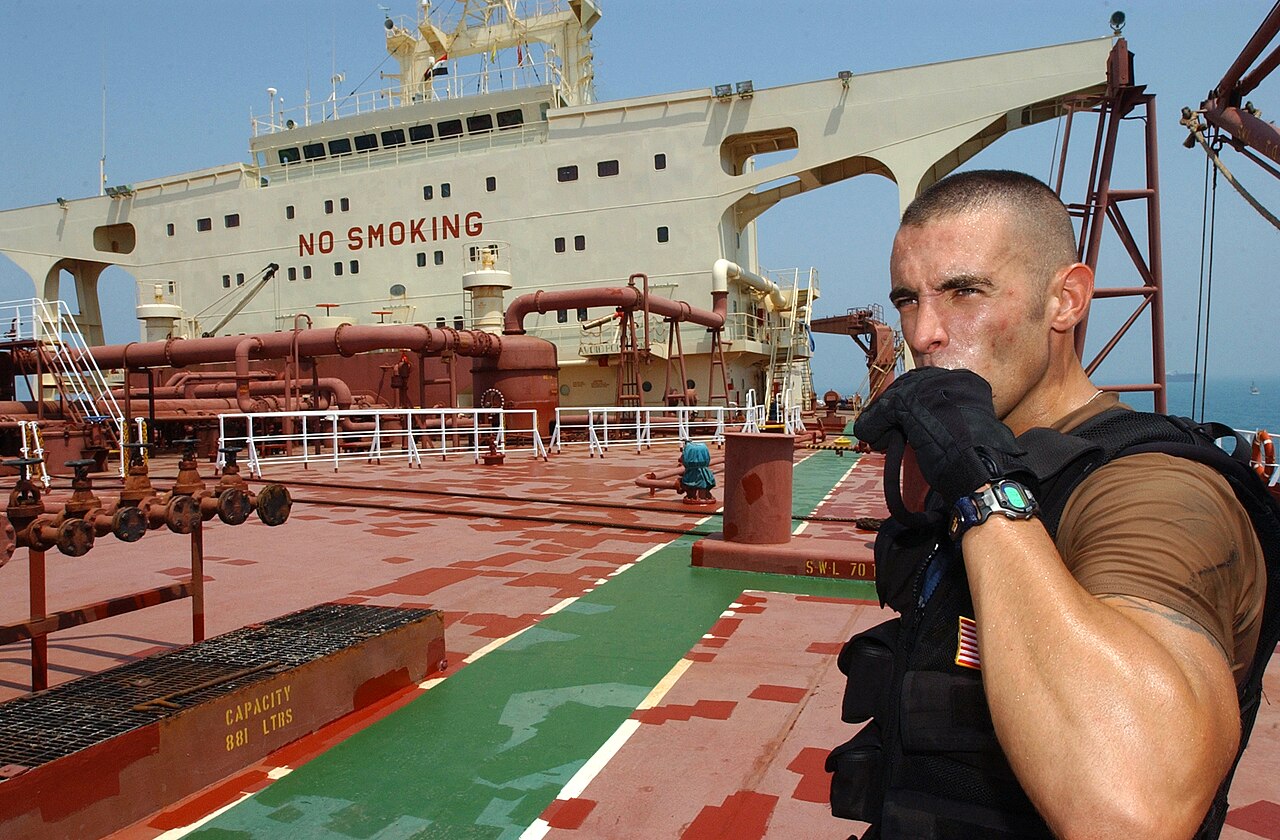
The Strait of Hormuz is a narrow waterway — roughly 21 miles wide at its narrowest point — separating Iran from Oman and the United Arab Emirates, connecting the Persian Gulf to the Gulf of Oman and the open Arabian Sea beyond. It is the only sea passage through which oil exported from Saudi Arabia, Iraq, Kuwait, the UAE, Qatar, and Bahrain can reach the global market via tanker. According to the U.S. Energy Information Administration, this strait handles approximately one-fifth of the world’s total daily petroleum consumption, making any disruption there an immediate concern for global energy markets. Iran’s coastline runs along the strait’s northern shore, giving Tehran geographic leverage that it has periodically used to assert influence over maritime traffic. Iran’s Islamic Revolutionary Guard Corps Navy (IRGCN) operates fast-attack boats and has historically harassed, seized, or threatened commercial vessels in the waterway, particularly during periods of heightened tension with Western powers.
Trump’s characterization of Iranian transit fees as an “illegal toll” introduces a novel framing into an already complex legal landscape. Iran has historically claimed the right to regulate maritime traffic in waters it considers part of its territorial sea and exclusive economic zone. Under the United Nations Convention on the Law of the Sea (UNCLOS), ships of all nations enjoy the right of transit passage through straits used for international navigation, which includes the Strait of Hormuz. Notably, the United States has never ratified UNCLOS, though it generally observes its provisions as customary international law. Iran, which has ratified the convention, has at times disputed the scope of transit passage rights and imposed its own requirements on vessels. Whether these constitute an “illegal toll” or legitimate regulatory activity is a matter of significant legal and diplomatic debate. A U.S. naval blockade — a traditional act of war under international law — would represent a dramatic escalation beyond any previous American posture in the region, including the 1987–88 “Tanker War” operations during the Iran-Iraq conflict.
📚 Background & Context
U.S.-Iran tensions in the Strait of Hormuz have a long and volatile history. During Operation Earnest Will (1987–88), the U.S. Navy escorted reflagged Kuwaiti tankers through the Persian Gulf amid Iranian mining and missile attacks, culminating in Operation Praying Mantis — the largest American naval engagement since World War II — in which U.S. forces sank or damaged multiple Iranian warships. More recently, in 2019, Iran seized the British-flagged tanker Stena Impero and shot down a U.S. surveillance drone over the strait, nearly triggering a military response from the Trump administration during his first term. In 2023 and 2024, the IRGCN seized multiple commercial tankers, prompting the U.S. to increase its naval presence in the region. Any move toward a formal blockade would mark a qualitative shift from freedom-of-navigation operations to an offensive posture with potentially profound consequences under both domestic and international law.
The immediate implications of Trump’s threat are multifaceted. Energy markets are highly sensitive to any perceived threat to Hormuz traffic; even rhetorical escalation has historically triggered spikes in crude oil prices. Analysts will be watching closely for any movement of additional U.S. naval assets toward the Persian Gulf, any response from Iran’s military or diplomatic apparatus, and whether Congress asserts its war-powers authority. Under the War Powers Resolution of 1973, the president is required to notify Congress within 48 hours of committing armed forces to military action and is generally prohibited from sustaining hostilities beyond 60 days without congressional authorization. A blockade — legally considered an act of war — would almost certainly invite scrutiny from lawmakers on both sides of the aisle regarding executive authority. Additionally, U.S. allies in the Gulf Cooperation Council, as well as major energy-importing nations such as China, Japan, South Korea, and India, all have enormous stakes in the free flow of oil through the strait and could be drawn into diplomatic or logistical roles depending on how events unfold.
Iran has not yet issued a formal public response to Trump’s latest threat, though Tehran has historically warned that any disruption to its maritime activities would be met with asymmetric retaliation, including threats to close the strait entirely — a move that would devastate its own oil-dependent neighbors but also inflict severe damage on the global economy. The coming days and weeks will be critical in determining whether this represents a rhetorical escalation, a negotiating tactic designed to increase pressure ahead of potential nuclear talks, or a genuine precursor to military action in one of the world’s most strategically sensitive regions.
💬 What People Are Saying
Based on public reaction across social media and news platforms, here is the general consensus on this story:
- 🔴Conservative and right-leaning commentators have largely expressed support for Trump’s posture, arguing that Iran’s extraction of fees from commercial shipping amounts to extortion and that only credible threats of force can deter Tehran’s aggression. Many view the stance as a reassertion of American naval dominance and a necessary step to protect global energy security and allied interests in the Gulf.
- 🔵Liberal and left-leaning voices have raised alarm about the threat of unilateral military escalation without congressional authorization, warning that a blockade could spiral into a full-scale conflict with catastrophic humanitarian and economic consequences. Some have called for renewed diplomatic engagement and questioned whether the administration is using the situation to distract from domestic political pressures.
- 🟠The broader public reaction reflects widespread anxiety about the potential for armed conflict and rising oil prices. Many observers across the political spectrum are urging caution, noting that the Strait of Hormuz has been a flashpoint for decades and that miscalculation by either side could have devastating global repercussions far beyond the Middle East.
Note: Social reactions represent general public sentiment and do not reflect Political.org’s editorial position.
Photo: Official Navy Page from United States of America
Alex R. Forster/U.S. Navy via Wikimedia Commons
Photo: U.S. Navy photo via Wikimedia Commons
Political.org
Nonpartisan political news and analysis. Fact-based reporting for informed citizens.





Leave a comment